Until One Day
Featuring artists of Gallery P8: Tal Buniel, Yinon Kalfon, Carmela Weiss, Sali Kristal, Ronit Mirsky, Rotem Bides, Tamar Lev-On
Curator: Lital Marcus Morin
23.4.26-2.7.26
lation that suspends the present on a future event whose form has not yet been decided. It may contain collapse, repair, forgetting, or perhaps change. Within this field of possibilities, hope operates as a practice of endurance: a repeated act of holding onto possibility even when knowledge undermines it.
In the exhibition, this tension is embodied in material, image, and language: the material carries traces of an event without determining its meaning; the image fixes a moment yet leaves it open to re-reading; and language turns toward the future, promises, and leaves a crack in its fulfillment.
In Carmela Weiss’s works, what appears to the eye does not yield itself. The objects function as spaces of closure and suspension; the gaze lingers on the threshold of revelation.
The work ‘One Morning’ is constructed as a closed composition based on the golden ratio, within which a sound source is hidden: the 18th-century English folk song ‘Early One Morning’, describing a young woman mourning a lover who abandoned her. The formal closure becomes a resonance chamber of loss, in which the lament remains trapped within a shell of perfect mathematical order.
‘Untitled’ stands as a complete and restrained unit reminiscent of a monolith: a sealed, opaque body hinting at an internal content that is never revealed. The object sustains a tension between physical stability and what remains trapped within it, inaccessible to the gaze.
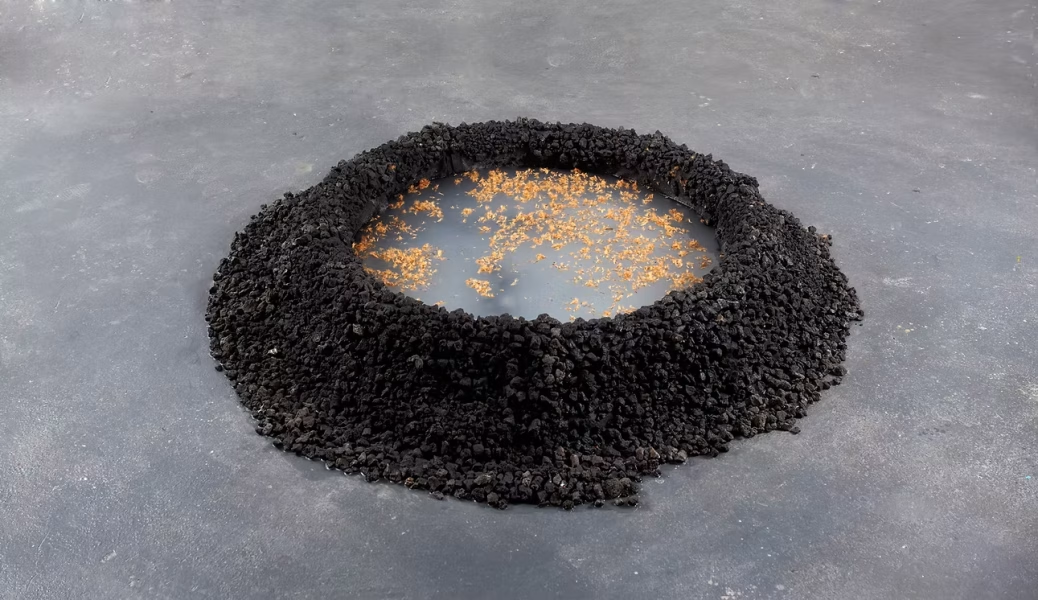
In ‘Source of Many Waters’, a volcanic stone pool, toxic oleander seeds float on murky water, charging the pool with a tension between vitality and annihilation.
In ‘Eye’, Sali Kristal embroiders the fragility of vision at the heart of a disrupted reality. She extracts a black thread structure from a surface that unravels and disappears, leaving what appears to be an anatomical cross-section of an eye, suspended in space.
The silhouette blurs its boundaries, undermining the distinction between material and its shadow, and casting doubt on the stability of perceptual categories through which identification takes place.
The embroidery is based on acts of joining and holding: the process is repetitive and measured, with each inaccuracy carrying the threat of unraveling.
At sixteen, Yinon Kalfon’s teacher rotated the angle of the photograph presented in the exhibition,”Before I Knew It”. A simple act that later solidified into a position within his work, redefining conditions of existence through the gaze: inversion as a mode of seeing. The gaze does not document reality but redefines it through displacement.
Years after the photograph was taken, the gaze is shifted once more, from the photographer to the photograph itself, which bears the traces of time’s passage. The image, seemingly frozen, contains movement: a moment preserved, yet still open to re-reading. The photograph fixes a moment of dispersion but does not close it; the motion remains stretched, suspending the moment without stabilizing it.
Ronit Mirsky’s works engage material and memory as practices of transformation. In ‘Ash and Gold’, charred tree trunks she collected from the Judean Hills following the 2025 fires are interwoven with gold sinews in a process of repair that carries an alchemical character. Mirsky does not seek to erase trauma but marks the fracture as a potential site of repair.
The work ‘Silver and Olive’ turns toward a space of uncertainty. On a silver, mirror-like surface, a delicate engraving of a tree produces a distorted reflection, placing the viewer in a process of searching and attunement. The mirror does not aim to affirm reality but to challenge it, positioning the viewer within a threshold of uncertainty between poetic fiction and a future yet to take shape.
In the print series ‘Tree No. 1, Tree No. 2’, Rotem Bides transfers onto paper the traces of tree stumps from Ravensbrück, the largest women’s concentration camp in Germany, later turned into an extermination camp. She extracts a voice from the silence of the landscape, turning the tree into a witness carrying the sediment of the past in its fibers.
Her work undermines historiographical conventions and formulates the possibility of viewing crimes against humanity as events that leave traces both in cultural memory and in the material memory of the environment. In doing so, she proposes a reading of history through vegetation, through the rings of the trunk bearing the record of the years in which the horror occurred.
In ‘Arca’, Tal Buniel transforms the archival space into a pulsating language trap. Through a monumental letter without punctuation, without an addressee and without a signature, he fuses the laconic, opaque language of institutional systems with fragments of intimate memory, seeking to trace the remnants of his brother Yehuda, who died in infancy.
“Arca” (Latin for “chest” or “ark”) is both shelter and place of confinement. Buniel’s archive is not a repository of knowledge but a mechanism of deferral, in which the personal request is swallowed into institutional language and dissolves within it.
Tamar Lev-On’s work, ‘Untitled’, from the series ‘Ailments’, is presented here as a single unit, detached from its original context. It shifts the gaze from sequence to suspension, placing the viewer before a simple yet demanding act: to notice it. The bright circle opening within a dark field of drawing exists as a site of attunement, grounded in the layers of drawing from which it emerges.
Mark by mark, on a surface that grows darker, an attempt takes shape to hold onto possibility even as stability unravels.
—
¹ Measure for Measure (c. 1604), Act 3, Scene 1, Claudio:
“The miserable have no other medicine / But only hope.”